Rawalpindi
Midnight's ChildrenRawalpindi is the Pakistani city where Saleem and his family settle after leaving Bombay, and where General Zulfikar’s military household makes national politics part of the child’s daily surroundings. The family’s arrival turns exile into a place: a guarded estate, a carefully managed household, and, on October 7, 1958, the scene of a coup Saleem first understands through its people and rooms rather than through political theory.
Arrival and setting
After Saleem’s mother leaves Ahmed, Reverend Mother directs Emerald to take Amina, Saleem, the Brass Monkey, and Pia to Pakistan. General Zulfikar and Emerald agree, and the family departs while Ahmed remains behind with Alice Pereira. The move also separates Saleem from the Midnight Children’s Conference: he discovers that the frontier has jammed his thought-transmissions to the other children, making exile both geographical and psychic.
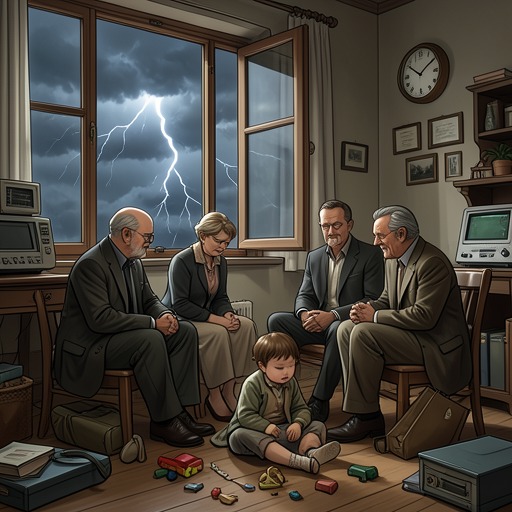
The family reaches Rawalpindi by hot, dusty train. General Zulfikar and Emerald travel air-conditioned, while the others ride ordinary first class. Saleem remembers the city as low and anonymous, marked by barracks, fruit shops, a sports-goods industry, military men, jeeps, furniture carvers, and polo. The family’s new home stands in an expensive development behind a high wall topped with barbed wire and patrolled by sentries. Inside, costly furniture and a dining-room wall containing a fish tank coexist with a dull, lifeless atmosphere. Servants wear green military jerseys and berets; the General’s refrain, “Let’s get organized!”, gives the household the sound of command.
The Zulfikar household and the family
Rawalpindi is also where Saleem’s sense of belonging is tested. His mother, deprived of her two husbands and her former sense of purpose, begins to wither in the northern cold. She tells Saleem that love is learned rather than present automatically at birth, and says she has spent eleven years learning to love him as her son. The tenderness does not erase the distance Saleem senses in her words or the difficulty the family faces in absorbing Mary Pereira’s confession about his birth. He remains afraid of Shiva and driven to prove that he deserves the kinship offered by Amina and the Brass Monkey.
The General’s house gathers these private uncertainties around a political center. As preparations begin for a dinner party, eleven-year-old Saleem notices security officers hiding in the garden, Emerald wearing her finest jewels, and a guest list whose names are withheld from him. A line of black limousines enters through the sentried walls, their passengers unsmiling. The women of the household stand behind General Zulfikar with expressions Saleem associates with a funeral. He cannot explain the political crisis, but the house’s secrecy and ceremonial tension tell him that something momentous is under way.
The 1958 coup
At dinner, the guests’ discussion shifts from the politicians’ year in power to the military’s decision to take control. Saleem is allowed to remain at the table with his cousin Zafar, and hears General Ayub Khan announce that he is assuming control of the state. Ayub declares the Constitution abrogated, the central and provincial legislatures dissolved, and political parties abolished; he then imposes martial law. Saleem recognizes the act as treason, even though he does not understand the constitutional history behind it. Zafar, frightened, loses control of his bladder, and the adults’ laughter makes the announcement intimate and humiliating as well as historic.
The coup is first reduced to a tabletop model in the children’s play with pepperpots and table ornaments. A silver cream jug stands for President Iskander Mirza, who remains president for three weeks. At midnight on November 1, General Zulfikar wakes Saleem and takes him along in a fast-moving convoy. They enter a guarded house and find Mirza in bed. Zulfikar orders him to come with them; Saleem accompanies his uncle as the former president is driven to a military airfield and put on a departing aircraft. Saleem narrates the episode as the point when the playful tabletop overthrow becomes an actual removal of a government and the exile of a president.
Exile and recurring journeys
Rawalpindi’s place in the novel is bound to movement across borders. Saleem arrives aboard the SS Sabarmati, whose passing sister ship is the Sarasvati; the names recall Commander Sabarmati and make the passage into exile another instance of the novel’s recurring patterns. Later, after the destruction of his family and the loss of his connection to history, Saleem returns to the capital by train. He waits beyond the platform at Benares station and clings to a departing first-class carriage, begging to be let in—now on the outside of a train whose passengers repeat the earlier refusal to admit fare-dodgers.
Rawalpindi therefore functions not only as a location but as a threshold between home and political displacement. Its walls and sentries contain a family, yet the household is exposed to the state’s changing order; its train journeys bring Saleem into Pakistan and later carry him away from the life that began there. The coup enters his memory through a dinner table, a guarded house, and a midnight car ride, joining the intimate scale of childhood to the machinery of national power.